
80% AI. 100% human.
Why it doesn't matter that a machine did most of the work — and the one thing it still can't supply.

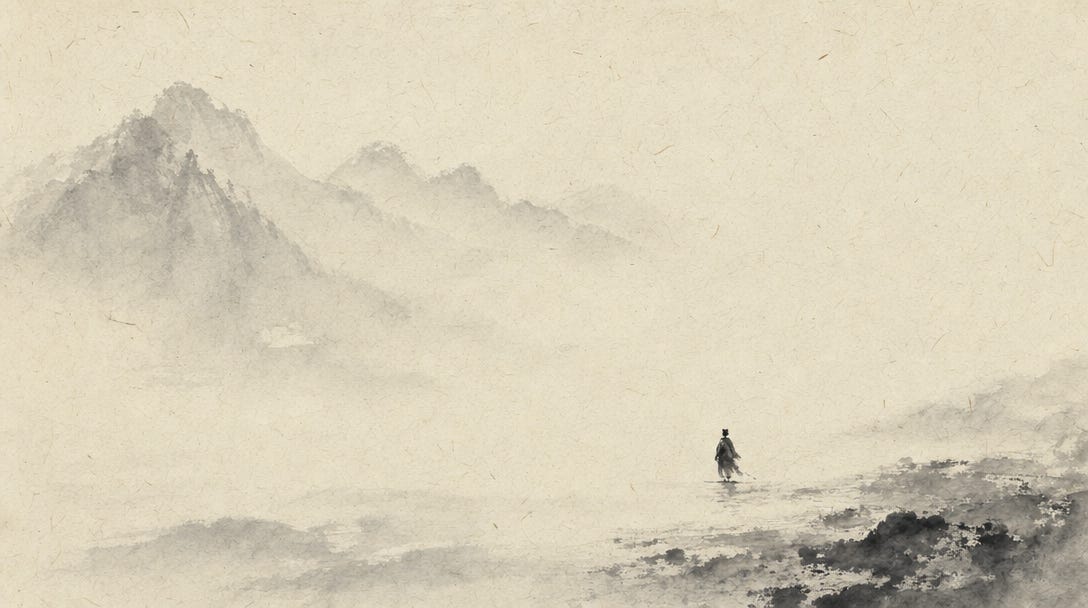
The fish trap exists because of the fish; once you’ve gotten the fish, you can forget the trap.
— Zhuangzi, “External Things,” trans. Burton Watson
Earlier this year a masked duo from Québec started showing up everywhere I looked. Angine de Poitrine — literally angina pectoris, the clenching chest pain of a heart short on blood — two people in masks, playing a version of rock that still left me weirdly uncomfortable. The reception was enormous: a KEXP live set with sixteen million views on YouTube, a perfect ten from Canada’s leading national music magazine, a nomination for Canada’s national music prize, Foo Fighter’s frontman Dave Grohl calling them completely bonkers.
Underneath the praise, in the comments, one kind of relief kept surfacing: no machine could make something this weird. The internet had found its antidote to the perceived rise of AI-made content, and said so, loudly.
What sixteen million people felt was the print of those two — their strange, particular taste, the exact way only they hear and play. That specific source is what reached them; the machine talk was just how they named it.
Most people meet AI with one question: is it going to take my job? I’ve made the case before that this is the wrong question — that what matters isn’t which of your tasks get automated but where you end up sitting in the system doing the automating, above the algorithm or below it.
Underneath the job question is something bigger: as more and more of everything gets made with these tools, what stays mine? What room is left for a human?
Everything you make splits into two layers. One is what it’s about — the argument, the summary, the information — the abundant, copyable, heading-toward-free commodity.
The other is what it does to the person on the receiving end: the trace of one specific source meeting one specific reader. The machine can make the first without limit. The second is the only room left for you.
What’s left when the making gets cheap
Making things got cheap. A decent draft, a working script, a passable design, a clean summary of a long report — near-free now, available to anyone, in seconds. That already happened. We’re swimming in it.
The question competence used to answer — can you do the thing? — has stopped sorting people. Not because everyone got good — most people didn’t. The machine just hands the competent version to anyone who asks, at a price near zero.
Take something small and exact: hand an AI a video and it will tell you what it’s about — the themes, the structure, the beats. I’ve done it; the summary comes back fast, often better than the one I’d have written myself.
What it cannot do is have the feeling that video left in you.
It has no afternoon it watched the thing on, no life of its own for the scene to land in and press against — it can read the film, but it was never someone the film happened to.
The machine can’t be the particular source a thing comes from, or the particular life it lands in.
“Feeling” is too soft a word to carry the weight of that gap. What actually reaches a stranger is the print of one particular person — their experience, their taste, the specific way they make sense of things. A model has no particular self to draw from.
What it gives back is the blur of everyone at once: the smooth, middle version, true of anyone and so of no one. Ask it for a personal story and it hands you a personal story: well-shaped, attached to nobody’s actual Tuesday. Yours is attached to yours. That attachment is the entire difference.
But the machine is getting good at faking it
The comfortable version of this argument is already wrong: AI is getting good at faking the human layer — a passable voice, a plausible, authentic-sounding story — and every time I check, the fake has gotten a little better.
What survives is narrower: the machine fakes the average of the lived; it can’t fake the specifically yours, because it never had your Tuesday. The exact detail, the named consequence, the read only your history would land on — that’s where the fake thins. Specificity is the tell, and anyone who tells you otherwise is selling comfort.
The floor under “good enough” keeps rising, and some weeks I can’t tell how high it goes. Worse: most of what any of us makes is the copyable average anyway, mine included — the specifically-yours layer is thinner and rarer than we like to admit, and a lot of what feels personal is just competent.
The comforting claim — that you’re safe because you’re human — is the wrong one. The honest claim is narrower: there’s a layer only you can supply, smaller than you think, and the whole game is finding it and putting it in on purpose.
AI doesn’t matter
It does not matter that AI made it. The words, the notes, the structure — eighty percent of your essay can be machine-assisted. I write at roughly eighty percent AI myself, and I’ll defend the number. What matters is whether the finished thing carries a specific human source — your experience, your taste, your way of making sense of the world. That’s the one input nobody else can supply — and the one a stranger feels on the far end.
Is this AI, or is it human? was always the wrong question. The one that holds is older and dumber: does this make me feel something, or think something I hadn’t? That’s the only test for slop that survives contact with a real reader, and it doesn’t care which tool you used. Judge the effect, not the origin.
It’s also why a story does the work it does — and why it isn’t the growth hack it gets sold as. A truism copies infinitely: a tip, a framework, a clever reframe is information, and information is what the machine drives toward free.
A lived moment rendered at the right pitch does not copy, because you’re its only supplier — it exists in one inventory. Telling the real thing isn’t decorating an argument; it’s handing over the one part of the work that can’t be pulled from the distribution. A story is one person’s source, made portable — that’s all it’s ever doing.
The room is already getting priced
Two things I keep noticing: the live show sells out while the recording it’s built on streams for almost nothing, and people are paying, again, to be in rooms — meetups, small communities, real people making things for other real people.
I felt it myself at recent meetup in Hong Kong — a room full of people building with the same tools I use every day. The information in that room I could have found anywhere. What I couldn’t find was the presence — everyone there had actually lived the thing we came to talk about, not just read about it.
I want to be careful how hard I lean on that — a couple of rooms and one masked band aren’t a market study. Call it a pattern, not a law: as the copyable turns abundant, the un-copyable goes premium. Angine is one instance, the sold-out room another. If I’m right, it’s less a trend than a fork — and it’s pointed at you.
Down one path you become one more interchangeable input in an agentic workflow — a step that summarizes and reformats, priced at zero because the next input does the job just as well. That’s below the algorithm.
Down the other, you make the thing only you can, and aim the same tools at what no one else supplies — in my own work they let one person reach further than a small team could a few years ago.
Either you supply the source, or let the machine fake it because that was faster.
Let the machine build the competent vehicle — draft it, structure it, make every sentence go down clean. What reaches another person was never the vehicle. The thing worth guarding isn’t a sharper prompt. What’s carried inside is either yours or it isn’t.
The most personal thing I’ve made, I made with a machine
The most personal thing I’ve ever published, I wrote with AI. It’s about moving my family to Hong Kong, a hard run of managers, and the slow realization that I’d been measuring my own worth through the judgment of the office. I typed a lot of it to a chatbot late at night, because I had nowhere else to put it. And by my own numbers, it’s the piece of mine that’s traveled the furthest — because only I could have been its source.
“Vulnerability” and “authenticity” are labels we paste on afterward. What made it land is that a specific experience from my own life was rendered so that a stranger felt a version of it in their own life. The tool moved the words around. It could not have been the source, because it never had the year.
A test for the next thing you make
Something small enough to do today: take the next thing you make with AI — the email, the post, the deck, the essay — and before you send it, go looking for the one detail only you could have supplied: the specific consequence, the thing that actually happened to you on some ordinary Tuesday. Plenty of lines will sound personal; the one you’re after could only be yours. Find it, and the piece will carry it. Come up empty, and that’s an answer too — one some part of you probably already had. Most of the discipline is just being willing to look.
The fish trap returns: the old teacher said forget the trap, once you have the fish. AI has perfected the trap — a flawless one, endless, free, a perfect container nobody was ever actually after. The fish was always the thing on the far side: one specific person, reaching one specific reader, across the distance between them. Let the machine make the trap. Just don’t mistake it for the fish.
Look at the last thing you made, and be honest about it. Whose source was in it? Did you put it there — or did you hand the reader a plausible average and hope they wouldn’t feel the difference? That is the whole of what this age is asking. And it is still, entirely, yours to answer.
A note on how this was made: I outlined and drafted this with Claude. The experiences, the opinions, and the read of what it all means are mine. The machine helped with structure, pacing, and getting the words out of my head and onto the page. A piece arguing that it doesn’t matter whether AI helped should probably admit that AI helped. It did. The source is still me.