
A machine can read your journals. It still can't write your story.
On keeping the shelf stocked and the taste trained, now that a model can hold your memories too.

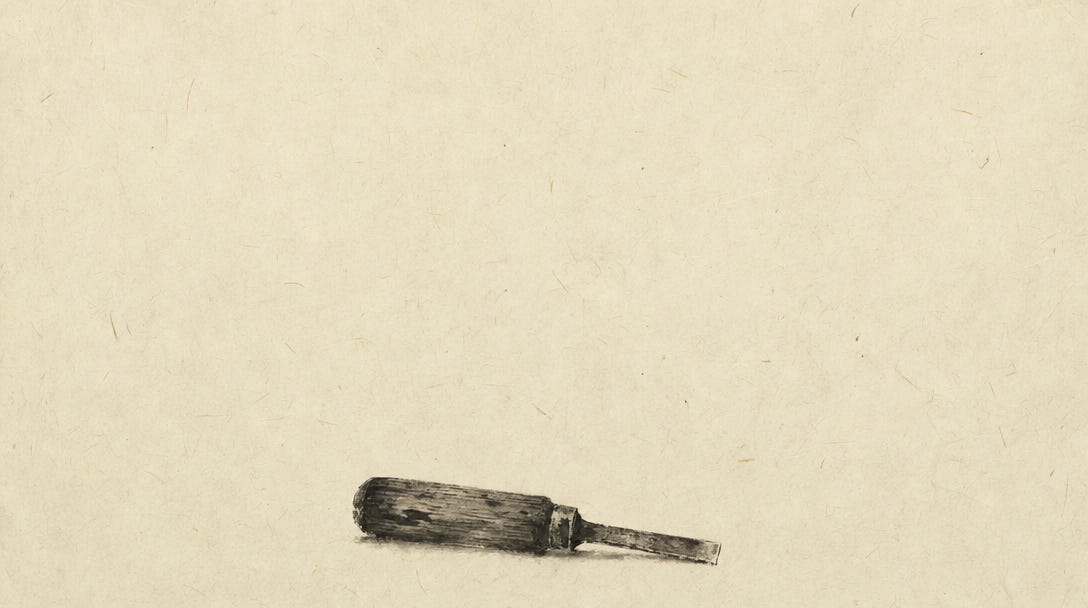
You can’t put it into words, and yet there’s a knack to it somehow. I can’t teach it to my son, and he can’t learn it from me. … When the men of old died, they took with them the things that couldn’t be handed down.
— Zhuangzi, “The Way of Heaven,” trans. Burton Watson
Not long ago I spent a whole day running everything through AI — hardening a spec for an always-on system built to draft prose in my voice, while in the same hours turning out three pieces for work: team scorecards, a recommendation for a senior leader, a comprehension check on another deliverable. Not a line by hand.
Somewhere in the afternoon the joke of it landed: the machine I was specifying to write like me couldn’t have produced a single thing I shipped that day — not because I’d kept it at arm’s length, but because it was in everything and still couldn’t do the actual work.
Over and over, all day, I was doing one small operation: matching a candidate out of a larger set to the decision it had to serve. Which finding goes in which box. Which framing fits which reader. Which of forty possible lines earns the one slot on the slide. Not writing — deciding.
I wrote about this a couple of weeks ago, from the outside: everything you make splits into two layers — the copyable one a machine turns out without limit, and the one only you can supply, the trace of your specific source meeting a specific reader — and it doesn’t matter that the machine did most of the work, as long as the finished thing carries the layer only you have. This was the same claim from inside a working day: eighty percent AI, the hundred-percent-human part was the deciding.
That piece named the layer only you can supply: the lived, specific moment, rendered so a stranger feels it. It left a harder question open — if a model can produce fluent prose on demand, and can even hold your raw material once you feed it your journals, what’s the practice that stays yours?
The honest answer is two things: keeping the shelf stocked, and training the taste that selects from it. The day I spent building a machine to write in my place proved both without meaning to.
What a model is actually doing when it writes
Spend enough hours with one of these tools and you feel the shape of it: you ask for a paragraph, and it hands you the words that most plausibly come next, drawn from more human writing than any of us could read in a hundred lifetimes. What comes back is fluent because fluency is the thing it was trained to produce — it learned to sound like a knowledgeable person, which turns out to be very different than actually being one.
Sounding right and being right overlap often enough that you stop watching for the seam. But the seam is the whole story. The tool produces the plausible surface; whether anything true sits underneath was never what it was optimising for.
A long-form essay is two things stacked together: an argument, and the lived moments that illustrate it. The argument is the portable layer — the take, the framework, the structure you hang it on, the part you could hand to someone else and they could carry it. That layer is now cheap: a model can research it, synthesize it, and draft a fluent version in the time it takes to describe what you want.
Not all writing though — if a piece is built on original reporting, on evidence no one else has, on a genuinely new line of reasoning, the machine can’t hand you that; it isn’t in the distribution to be predicted. But most personal and opinion writing isn’t built on new reporting. Mine mostly isn’t — it’s a take assembled from what’s already known and sharpened into a point of view. For that layer, there’s no scarcity left to defend. It was never the scarce input; now that’s just plain to see.
The recycling trap
The other layer doesn’t move the same way. The specific moment from your own life, rendered in detail, exists in exactly one inventory, and you are the only supplier. A model can write a personal-sounding story on demand. It can’t write yours, because it was never there for it.
I catch myself in this one. Go back through anyone’s essays, mine included, and the same two or three strong stories carry piece after piece — not the best ones available, the only ones stocked. The shelf is thin, so the same coins keep getting spent, and the reader feels the repetition before the writer does. By the time you notice you’re reaching for the same old story, they noticed two essays ago.
The reflex, when the shelf runs low, is to treat it as a drafting problem — better prompts, tighter outlines, a cleaner structure to hang the thin material on. But no amount of writing harder in the moment restocks an empty shelf. This is a supply problem wearing a drafting problem’s clothes. What fixes it is more raw material, produced as its own step, upstream, before drafting starts — not scrambled for mid-draft when a section suddenly needs a story you don’t have.
But a model can read your journals
Feed a model your journals — years of daily entries — and it can retrieve your exact moments. The raw memory is right there in the text. So much for material only you can supply: it turns out the material can be handed over in an afternoon. That’s the strongest objection I know to any of this.
Half of it is right, and the half that’s right is the half about having been there. Having been there confers nothing on its own. The moments sit in the archive whether I mine them or not, and once they’re in a file they copy like any other file. What I was writing that day was proof of exactly that — a document describing a system that could produce prose in my voice. A spec is a possession. Hand it to someone else and it still works.
What the document couldn’t do was make the calls. Which line goes in which box. Which of forty moments serves this argument, for this reader. The spec could describe the voice; it couldn’t sit in the chair at six o’clock and decide.
The line at the top of this piece belongs to a wheelwright, and the story around it is worth telling properly. A duke sits up in his hall reading the books of the sages. Down in the yard, a wheelwright named Bian is chiselling a wheel.
Bian puts down his mallet, comes up, and asks what the duke is reading.
“The words of the sages,” the duke says.
“Are they alive?”
“Dead, long dead.”
“Then what you’re reading,” Bian says, “is the leavings of dead men.”
The duke threatens to have him executed unless he can justify that. So Bian explains.
When making a wheel with a wood chisel, strike too gently and it slides without biting. Strike too hard and it jams and won’t move. The right stroke sits somewhere between, and after seventy years he still can’t say where — he can feel it in his hand, and that’s the whole of it.
He can’t teach it to his son, and his son can’t take it from him, which is why at seventy he is still out in the yard cutting wheels himself. What the sages knew went the same way. What got written down is only what survived being put into words.
That’s the seam, and it’s the one I keep running into at my own desk. The residue is transferable — the book, the spec, the archive of journals. The rest has to be practiced directly, every time, by the person doing the work.
So the answer to the journals objection is narrower than “my memories are unfakeable.” A model can hold the raw material. What it can’t hold is the practice the material is only an input to: building the indexed shelf, judging which of forty moments illustrates this argument and not another, rendering the one detail at the pitch where it lands instead of the four that flatten it.
None of which is a bet the machine stays bad at choosing. It may get good enough to pick a defensible moment and render it cleanly. But a model that chooses well closes nothing, because the taste was never a capability out in the world to be matched — it’s built by making the call over and over. Let the model make the call and the call still gets made; what stops getting made is you.
Mining the shelf, training the taste
Both halves are things you do on purpose, on a schedule. The shelf first: make story-mining its own pass on the calendar, run before any piece begins, not improvised mid-draft when a paragraph needs a scene. The material is already in things you keep — episodic logs, journal entries, old drafts where a story showed up as one compressed sentence and the full arc never made the page.
You aren’t manufacturing memories; you’re indexing ones you already have. Capture each as a stub — a setup, a turn, what it reveals — and flag the ones already spent. The fastest way to restock usually isn’t a new memory; it’s finishing one you skimmed past the first time.
The taste gets trained in the same motion, which is the part people wave at and call a gift. When a story goes onto the shelf, tag it with the one argument it actually serves, and note what you’d cut to make it land — the extra details that flatten it, the part that’s true but doesn’t earn its place.
That second note is the taste, written down as a rep. It’s the same instinct any writer runs on a finished draft — would a stranger follow this, feel this — pointed one step earlier, at the shelf instead of the page.
Six o’clock, deciding which line goes where
Back to the day of the spec. The system I was hardening will keep getting better at producing plausible prose in my voice — I expect it to. What it still won’t do, a year from now or five, is sit at six o’clock and decide which of forty moments is right for this argument. That’s the same call I was making all day with the decks, just run against a different inventory. It was mine to make then. It’s mine to practice now.
That’s what the wheelwright kept pointing at, and it’s what I keep relearning at my own desk. The moat was never the memory sitting in the archive, waiting to be owned — it’s the mining, the selection, the pitch of the telling: the practice, not the possession.
So the move for me is small: put the mining on the calendar as its own block, run before the next draft needs it, not scrambled for mid-draft. The question I opened with — what’s left that’s mine? — has turned into a smaller one I can work on this week: when the next draft asks for a story, will the shelf be deep enough and the taste sharp enough that the part only I can supply is there? Or am I reaching for the same worn coin again, hoping no one notices?
A note on how this was made: I drafted this with an AI writing assistant. The day, the decisions, and the read of what they mean are mine; the tool helped with structure and getting the words out of my head onto the page. A piece arguing that the deciding is the part a machine can’t do should probably admit a machine helped move the words around. It did. The deciding was still mine.