
Rewiring your brain with purpose
The science and practice of gentle transformation

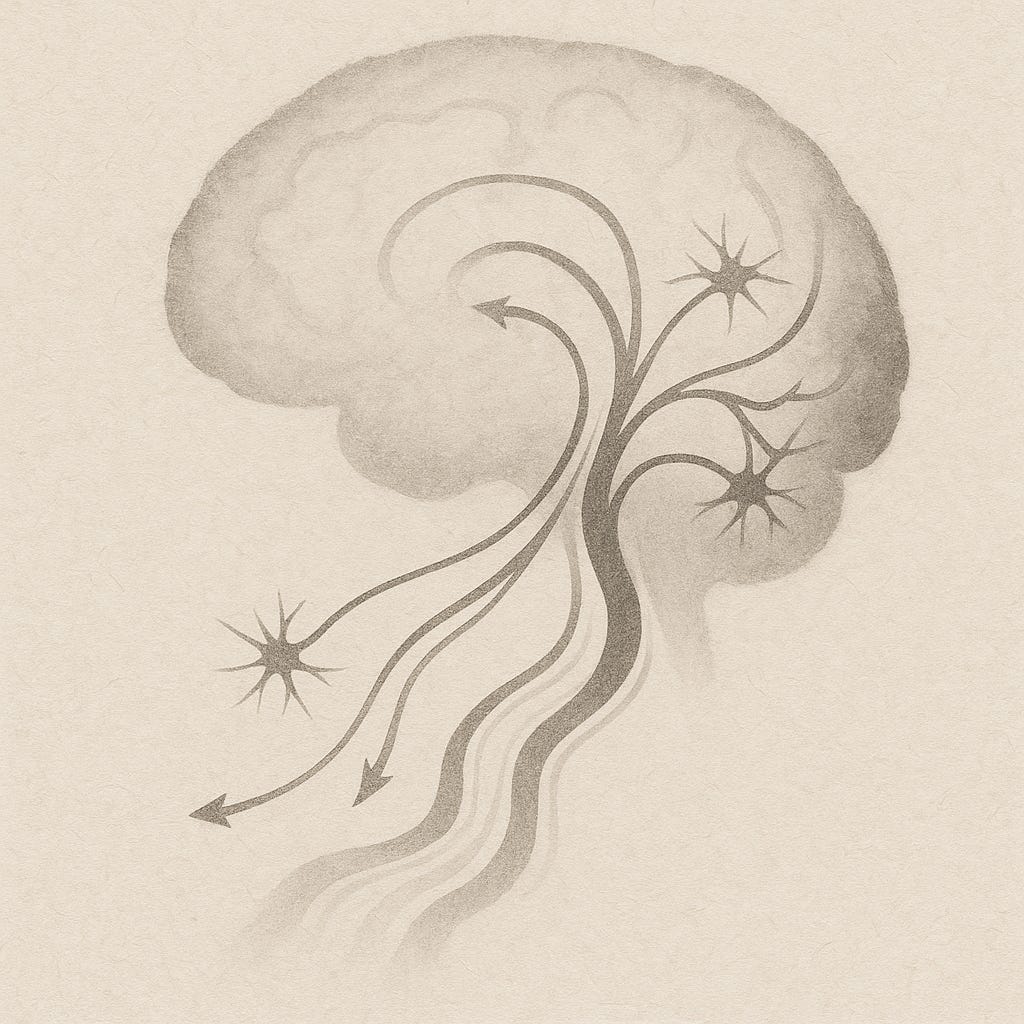
Nothing in the world is softer or weaker than water
Yet nothing is better at overcoming the hard and strong
- Laozi, Chapter 78
Water doesn't need to be taught how to flow downhill; it simply needs the right conditions. Your brain's natural capacity for change works the same way—purpose creates the slope that allows transformation to happen effortlessly.
Humans are the most unique animal on this planet. We come out of the womb with a brain that is only "half-baked," not fully maturing until our twenties. Even after that, study after study has shown that our brains are continually changing as its adapts to new environments, new people, new skills and new information.
Your brain houses billions of neurons forming trillions of connections—constantly rewiring itself based on what you pay attention to. Always seeking efficiency, the more that neurons communicate with each other, the easier and faster the communication becomes.
Think of the last time you learned a new skill. At first, it was really uncomfortable, maybe feeling downright impossible. But, as you practiced it more and more, it got easier and easier until voila you don't even need to think about how to do it anymore. That's neuroplasticity at work.
But here's what most self-help gurus don't tell you: Why do some people effortlessly maintain new habits while others struggle with the same goal for years?
While understanding the mechanics of brain change is important, equally crucial is how we approach this change. In my post on principles for gentle change, I explore why sustainable transformation requires compassion rather than force. The science of neuroplasticity confirms what wisdom traditions have taught for centuries—gentle, consistent practice creates more lasting change than harsh discipline.
If you want to intentionally rewire your brain—and the research suggests you can—there seem to be three key factors that accelerate the process::
Repetition: Consistent practice strengthens neural pathways.
Focus: Deep, concentrated practice has been shown to create stronger connections
Emotional salience: The more relevant and meaningful, the faster the connections will grow and the stronger they will be
Purpose acts as something like a master key—it doesn't just unlock one door, but creates conditions for your brain's natural change systems to work together.
Purpose becomes your motivational hub. It infuses ordinary actions with meaning, increases persistence when things get tough, and builds resilience when you face setbacks. Everything flows from it as it unconsciously directs your attention towards deeply meaningful change.
Your brain's natural change systems
Attention
Your brain constantly filters out an overwhelming amount of sensory input, directing cognitive resources to specific stimuli while suppressing irrelevant information.
But here's the interesting part: You have more control over this filtering system than you might think.
The frontoparietal network coordinates multiple brain regions to maintain goal-directed (top-down) attention. When searching for keys, it works with visual processing areas to enhance relevant features while suppressing distractions, essentially creating a neural filter tuned to your current goal.
Bottom-up attention, on the other hand, can be found in those weird moments when it feels like the universe literally revolves around you. Maybe you're in the middle of researching the best air fryer to buy when suddenly you start seeing air fryer ads on the side of buses and on street billboards. Or maybe you started a new diet and suddenly realized every TV commercial and conversation seemed to revolve around the exact foods you're trying to avoid.
In either case of top-down or bottom-up attention, we have more power to influence these systems than we think. As you bring deep focus and concentration (top-down) to bear on your purpose and how it can be applied in your life, you are strengthening the brain connections not only related to keeping the purpose in memory, but also priming yourself with an unconscious bias (bottom-up) towards noticing more ideas and opportunities related to that purpose.
Now, before this sounds like another 'manifestation' pitch—it's not. The science here is less about wishful thinking and more about programming your mental spotlight by:
Priming through morning rituals and strategic environmental cues like pictures or post-its
Training your attention through meditation, mindfulness and deliberate practice
Designing your environment to minimize distractions and create context-specific triggers
Quick win: Purpose filter
Create visual reminders based on your purpose, principles and/or vision.
Use AI to generate pictures with words or imagery directly tied to these and put them in places you'll see often like your phone's lock screen, computer background or even print them out.
Before making a decision, reference your purpose or the images you've created and ask, "Does this align with my purpose/principles/vision?"
The first generates environmental cues to remind and prime your attention while the second engages your prefrontal cortex to override automatic responses. Put together, these two steps trains your attentional bias to automatically notice purpose-aligned stimuli in your environment.
As your attention system gets better at noticing purpose-aligned opportunities, it creates better conditions for building new habits. These repeated moments of focused awareness become cues that trigger habit loops.
Habit
Habits form through cue-behavior-reward loops that become automated in specific circuits within the basal ganglia. This network of structures doesn't just control movement—it's crucial for learning which actions lead to rewards, allowing efficient behavior patterns to become automatic
Habits stick (or don't) for a number of reasons:
Consistency: Neural pathways strengthen through repetition and weaken through disuse
Context: Triggers in the environment or situation strongly influence habit activation (Gym clothes = time to exercise)
Reward: Dopamine reinforces behaviors that bring immediate gratification
Friction: Small barriers can derail habit formation before they become automatic
Identity: Habits that are aligned with your self-image are easier to implement, those that contradict will face strong internal resistance
With a clear and meaningful purpose, you can super charge habit change since purpose provides intrinsic motivation that persists beyond just external rewards. When your habits align with your purpose, even difficult tasks or situations feel rewarding ("I'm proud of myself for taking a small step in the right direction"). Not only do purpose aligned-habits activate reward circuits but also the networks that create meaning.
Quick win: Purpose-stacking
Use existing neural pathways to bootstrap new habit formation with minimal resistance.
Select one existing daily habit as an anchor (eg, morning coffee)
Immediately after this anchor, perform a small-purpose aligned action (eg, a self-care routine, journaling, affirmations or meditation)
State (out loud if you can) how this action connects to your purpose
Gradually increase the complexity of the stacked behavior as it becomes automatic
For me, this was my morning and evening routines incorporating the many elements of my system I'm trying to grow into. Start small and don't forget to be gentle when you slip up.
These purpose-aligned habits don’t just change behavior—they reshape how you see yourself. Each small win reinforces neural pathways in your default mode network (DMN), gradually evolving your self-image.
Identity
Your brain's DMN activates when you're not focused on external tasks, integrating memories, emotions, and beliefs into a coherent sense of self. This network is particularly active when you're reflecting on your purpose or values, helping wire them into your core identity.
Active during daydreaming, mind-wandering and self-reflection, the DMN's self-referential processing integrates what you experience into your self-image, physically reshaping relevant neural connections.
In this process, your brain wants to maintain consistency between behavior and self-concept, explaining why feelings of discomfort, anxiety or frustration are the best signs that something in your life needs empathetic investigation.
The stories that you tell yourself feed into your selective attention systems, filtering perception and amplifying identity-relevant stimuli.
Purpose provides a powerful coherent narrative to help you evolved your identity. Using identity statements ("I am the type of person who. . . "), we create narratives that we automatically want to follow to reduce cognitive dissonance, thus requiring less willpower.
Quick win: Identity shift
Review your purpose/principles/vision and write 1 identity statement for each one.
Recite these statements during a specific daily trigger
Throughout the day, note down actions that confirm your new identity. Actions that don't are best ignored — we're looking for wins, no matter how small
Review your notes and journals weekly. Reflect on how your identity is shifting.
Here are some of my identity statements:
Purpose: My purpose is to seek and share wisdom with curiosity, empathy, and objectivity—helping others understand themselves and the world around them.
Identity statement: I am someone who seeks and shares wisdom, approaching each day with curiosity and empathy.
Principle: Recognize that there is always a lesson the universe is trying to teach me in both good times and bad
Identity statement: I am a lifelong learner who welcomes each challenge as a lesson, growing wiser and steadier with every step.
Vision: By 2030, I will be living in alignment with my core values as an advisor and coach, using my skills to help people understand themselves with curiosity and empathy.
Identity statement: I am an entrepreneur and writer, building a thriving coaching practice that empowers others through deep understanding.
As your identity evolves, it reshapes what your attention system naturally picks up on. Your strengthened self-image acts like a lens, automatically directing focus toward opportunities that align with who you're becoming. This creates a powerful feedback loop: attention shapes habits, habits build identity, and identity guides attention—all organized around your core purpose.
Finding your true north
Large language models (LLMs) like ChatGPT are uniquely suited for purpose discovery. Unlike traditional self-reflection or journaling, LLMs can:
Spot patterns in your thinking you might miss
Ask probing follow-up questions based on your responses
Help refine vague ideas into clear statements
Provide an objective outside perspective
Purpose prompt
What it does: Facilitates purpose discovery by leading you through a structured reflection. After asking you questions about your motivation, what brings you satisfaction as well as your core values, the prompt will output a concise purpose statement.
When to use it: At any point in your journey where you feel purposeless or unmotivated. You can also re-run it on a regular basis, say once every year or two
Principles prompt
What it does: Guides the discovery of your core values and principles through a structured reflection and output a list of clear, actionable principles to guide your actions and decisions.
When to use it: After you’ve gone through the purpose discovery process. Having your purpose in hand will help guide your responses
Vision prompt
What it does: Clarifies your three-to-five year vision and creates a plan to achieve it by visualizing where you will be and what you will be doing. The LLM will prompt further reflection on key areas and encourage you to dream big but keep it grounded in authenticity and meaning
When to use it: Connects your every day effort to your dreams and aspirations
Working with LLMs for purpose discovery
Getting the most out of these prompts requires a bit of strategy and a bit of intuition:
How to engage
Be detailed: The more context you provide, the better the LLM can spot patterns and insights
Stay honest: Don't filter responses to sound "better" - authenticity matters more than perfection
Push back: If a suggestion feels off, say so. The LLM can adjust and offer alternatives
Ask questions: Use the LLM to explore angles you hadn't considered
Reading the signals
Trust your gut: Your emotional response is a powerful guide. Excitement and butterflies usually mean you're onto something true. Anxiety or resistance often signals misalignment
Take time: Let insights settle between sessions. Your brain needs space to process and integrate new perspectives
Look for patterns: What themes keep coming up across different conversations? These often point to core truths
Start small: Test purpose statements and principles in small ways before making big changes
Be on the lookout for these common assumptions:
Assumption: The first output must be perfect
Reality: Use LLMs iteratively. Initial outputs are starting points—raw material to refine through multiple conversations. If something doesn't resonate, push back and ask for alternatives.
Assumption: Purpose comes in a flash of insight
Reality: LLMs excel at gradual exploration. Use them to spot patterns across multiple conversations, test different angles, and evolve your understanding over time.
Assumption: Purpose must be grandiose
Reality: LLMs can help surface meaning in everyday life. They're great at connecting small actions to larger purposes, showing how ordinary contributions matter.
Assumption: The LLM knows better than you
Reality: Trust your gut. If something feels off, it probably is. Use the LLM as a thought partner, not an authority. Its job is to help you discover your truth, not prescribe it.
Assumption: Purpose requires complete transformation
Reality: Let LLMs help identify small, consistent actions. They're excellent at breaking down big purposes into manageable steps and showing how current activities might already align.
Assumption: Purpose is purely emotional
Reality: Use LLMs to balance inspiration with practicality. They can help craft purpose statements that engage both heart and head, combining meaningful direction with actionable frameworks.
A natural path to change
This approach to change aligns perfectly with the principles I've outlined previously. The gentleness I advocate isn't passive acceptance—it's strategic collaboration with your brain's natural mechanisms.
Instead of trying to force purpose into existence like another item on our self-improvement checklist, we can apply the principles of gentle progress to work with our neurology instead of fighting against it.
Your brain is already wired for meaningful change. Purpose isn't a goal to achieve but a way of working with your neural machinery's natural tendencies. When you align with these mechanisms, transformation becomes less about forcing change and more about creating the conditions for change to emerge.
The tools and systems described here aren't just techniques—they're ways of partnering with your brain's innate wisdom. The rest is just gravity.
A note on AI collaboration: This post was written with the assistance of AI tools, mostly as a thought partner and editor. While AI helped refine ideas and structure, all concepts, experiences, and insights are authentic to my understanding and practice.