
The alchemy of negative emotions
Sitting in the heat long enough to turn lead into gold

Author’s note: This one is longer than usual. The subject asked for it. Thanks for your patience.
“Like a pearl forming around an irritating grain of sand, wisdom develops through engaging with life’s challenges.”
— Brian Browne Walker
You’re standing in a room full of colleagues, blood hot, and the thing you want to say will make everything worse. You know this. You’re not sure you care. Your rational mind is somewhere behind you, watching from a distance while something older and louder takes the wheel. You’re not thinking anymore. You’re flooded — basically two years old again, except people expect composure and you have overdue credit card payments.
I’ve been here more times than I’d like to admit. The kind of angry where destruction is genuinely available — say the thing, make them feel what you’re feeling, hand them the weight you’re carrying. The kind where you’re not processing anymore, just reacting. Where the world has become clearly hostile and your only instinct is to be hostile right back.
Most of us have a playbook for this. Suppress it — shove it down, act professional, get through the meeting. Vent it — call someone after, dump the whole thing, feel temporarily lighter. Or just wait it out — stare at the ceiling, let the charge fade on its own. These aren’t bad strategies. They get you through the day. You go home, you sleep, you come back tomorrow with the edges dulled. Life continues.
But the feeling keeps coming back. Different meeting, different person, same flood. The suppression holds until it doesn’t. The venting helps until you notice you’re having the same conversation for the third time. The waiting works until you realise you’ve been waiting for months and nothing has actually changed. You’re managing the symptoms, over and over, and the thing underneath — the anger, the frustration, the intensity that makes everything land harder than it seems to land on everyone else — is still right there.
What I didn’t figure out until I’d spent years cycling through those same three moves was that the emotions I was trying to get rid of weren’t the problem. They weren’t a malfunction. They weren’t a sign that something was wrong with me — that I was too sensitive, too reactive, too much.
They were fuel. Raw, volatile, completely undirected — energy that I kept trying to discharge or contain when I could have been converting it into something useful. The question I should have been asking all along wasn’t how do I make this stop? It was what would happen if I stopped fighting it and started building with it instead? Not suppressing, not venting, not waiting. Something else entirely. Something that starts with sitting in the heat and seeing what it’s actually made of.
Raw material
There’s a concept in personality psychology called neuroticism — one of the Big Five traits. People who score high on it feel things more intensely than most. They notice what others gloss over. They get worked up by situations that everyone else seems to handle fine, or at least handle the internal part more easily. The trait gets a bad name because it looks like dysfunction from the outside: oversensitive, easily upset, annoying to be around. What it actually is, underneath the label, is a nervous system that generates more raw emotional material than average.
Most advice for people like this starts from the wrong premise. It treats the intensity as the problem — something to manage, medicate, or train out of yourself. Learn to let things go. Don’t take it personally. Develop a thicker skin. As if the goal is to feel less. But feeling less isn’t an upgrade. The intensity can be a resource — if you know what to do with it.
Lead into gold
For a long time, I didn’t. I just had the raw material and no process for working with it. What changed — slowly, imperfectly, over years — was learning a different way of relating to negative emotion. Not getting rid of it. Not acting on it. Converting it. Taking something heavy and toxic and, through a deliberate process of sitting with it, seeing through it, and redirecting it, turning it into something I could actually use.
The medieval alchemists had a word for this: transmutation. Converting one element into another — lead into gold — through heat and pressure. The emotional metaphor holds up better than the chemistry ever did. You take a material that’s heavy, volatile, seemingly worthless on its own. You don’t throw it away. You put it through a furnace. What comes out the other side has a completely different nature — not because the material disappeared, but because the process changed it.
Negative emotion is the lead. The anger, the frustration, the intensity that makes your chest tight and your thoughts race — that’s your base material. And the practice I’ve been learning is to stop trying to get rid of it and start putting it through the furnace instead.
Two versions of you
It starts with a choice. You’re in the fire — pressure from a situation you can’t control, feedback that feels unfair, a person who broke an unspoken contract. The urge to react is almost physical. And in that moment there are two versions of you available. There’s the one that wants to lash out, escalate, make the other person feel what you’re feeling. And there’s the one that knows — even if it’s just barely, even if the knowing is quiet and the anger is loud — that reacting from this place will cost you more than it costs them. That indulging the worst version of yourself is exactly how they win.
So you hold it. Not suppress it — that’s different, and the difference matters. Suppression is pushing the feeling down and pretending it isn’t there. Holding is keeping it in full view while choosing not to act on it. You feel the full weight. You let the pressure build. You don’t discharge it and you don’t deny it. You sit with it.
And then you ask one question: what can I actually do to make this better?
That question is the pivot. It moves you from victim of the feeling to someone who can work with it. The energy that was pointed at destruction gets redirected. Not into nothing. Into the next piece of work you do with more precision than the last. Into the conversation you handle with grace instead of fire. Into an honest look at where you could actually improve, stripped of excuses and defensiveness.
There’s a concept in classical Chinese philosophy that maps onto this almost exactly. The word is yuánqì (元气) — “origin qi,” the primordial life force said to exist at the core of all matter, living and non-living. Trees, rivers, animals, the air you breathe — everything carries this essence. In qi gong and martial arts traditions, the practice of working with qi is about learning to gather this energy, compress it, and direct it with intention. The Ba Duan Jin — the Eight Brocades, one of the oldest qi gong forms — is built around exactly this: movements designed to collect, concentrate, and circulate internal energy. I learned it years ago and still come back to it. There’s a moment in the practice where you’re standing still, hands pressed together, and you can feel the compression — everything drawn inward, held, waiting.
The principle — that energy can be gathered, held under pressure, and released with purpose — isn’t woo woo. It’s thousands of years old.
Quantum jump
Directed energy under pressure produces clarity. Athletes know this. Performers know it. Anyone who’s ever done their best work while furious knows it. The intensity doesn’t go away. It gets a direction. And what comes out the other side — the decisions you make, the work you produce, the way you show up for people — is stronger than what you’d have managed from a place of calm neutrality.
Ken Wilber calls this a “psychological quantum jump” — the idea that you can process trauma and negative energy in a way that catapults you to a higher level of consciousness. Not just back to baseline. Higher than where you started. You don’t have to be in the fire for this to happen. There are gentler paths — meditation, therapy, years of quiet practice. But the fire accelerates the jump in a way those slower paths can’t. It happens when you stop trying to escape and start using it.
The payoff gets you closer to something like enlightenment — closer to an elevated sense of being that’s more resilient, comes with more stamina, and carries a clearer sense of who you are condensed down to your very core.
And gradually, over time, the things that used to overwhelm you start to lose their grip — not because you stopped feeling them, but because you’ve been through the furnace enough times to know what’s on the other side.
The practitioner’s toolkit
So the alchemy is real — or at least, the principle is. You can take negative emotion and convert it into something useful. But knowing that and doing it consistently are very different things. The conversion doesn’t happen automatically. It depends on a set of skills that build on each other.
The foundation is self-awareness. You can’t convert what you can’t see.
Self-awareness sounds like something everyone has — we all think we know ourselves. But that illusion only holds as long as you never encounter the disconnect between who you think you are and what your behaviour actually shows. For me, that disconnect arrived in family life. I knew I wanted to be a good partner and father. I kept running into my own temper and a fundamental irritability I didn’t know I had. Not the kind of thing you can see from the inside while it’s happening. Only afterward — in the silence after you’ve snapped at your kid and watched their face change, or when you know you’ve hurt your partner’s feelings in a way you can’t take back.
Map and territory
That’s the gap between the map and the territory. Everyone walks around with a map of who they are. Self-awareness is checking the map against the actual terrain — and being willing to redraw it when they don’t match. Most people never check. The map feels right, so they trust it.
The practice is treating your thoughts and behaviour as if they’re external to you — observable, analysable, something you can hold up and examine. Not with perfect objectivity. Memory is fallible, emotion colours everything. But you can hold yourself to account through observation. The key is dispassion: the ability to look at your own patterns without immediately reacting to them. Not judging. Not punishing. Just seeing.
And this is harder than it sounds, because what you see isn’t always flattering. The temper you didn’t know you had. The defensiveness that kicks in before you’ve even finished hearing the feedback. The gap between the parent you want to be and the one who just raised his voice over something that didn’t matter. Self-awareness means sitting with all of that without flinching — not to wallow in it, but to understand it well enough to do something different next time.
You build it the way you build any skill — through repetition. Journaling. Meditation. The willingness to measure your actual self against your ideal self, honestly, again and again. Not to punish yourself. To close the gap. And here’s the thing about this particular skill: it’s recursive. You need some to get more. A baseline of self-awareness is required to even begin — to notice that there’s a gap worth examining. People with none can’t see the disconnect that would motivate them to start. But once you start, the cycle feeds itself. The more you see, the more you can change. The more you change, the more you trust the practice.
Inaction is a form of action
Once you can see clearly enough to know when you’re off-balance — to catch the feeling before it runs the show — the second skill becomes possible. And this is the one where the alchemy is most visible.
There are seasons — at work, in relationships, in life — where the situation won’t change no matter what you do. The difficulty isn’t going away. You don’t have the power to make it go away. A few years ago at work, the organisation was going through a full flip in corporate culture — leaders who were more than willing to make the people under them feel inadequate. Career progress was blocked by others. I couldn’t do anything. The only option was to prove through actions that I was valuable.
Quiet endurance is choosing to turn inward instead of outward. Not as defeat — as strategy. You save your energy for what you can actually control, influence, or impact. You stop spending it on what you can’t. You focus on what’s directly in front of you — the next smallest thing within your reach — and you keep moving, quietly.
This sounds passive. It isn’t. Choosing not to react when every part of you wants to — when the unfairness is real, when the frustration is justified, when you know you could say the thing that would make the room feel what you’re feeling — that takes more discipline than lashing out ever will. Inaction is a form of action. It’s a choice made repeatedly, under pressure, with real consequences.
When the external world gives you nothing to work with, the only furnace available is the internal one. That’s your lead. And because there’s nowhere else for the energy to go, you can either turn it inward and grow, or let it burn through your reserves fighting something that won’t move.
The I Ching talks about this directly. When the situation is against you, or you’re off-balance — retreat. Look inward. Find the lesson the universe is trying to teach you. These are the moments when the biggest leaps in growth are possible, precisely because the external options have been removed. The furnace runs hottest when there’s no escape hatch.
But the strategy only works if the inward work is real. Performing calm while seething inside isn’t endurance — it’s suppression wearing a mask. The practice has to go deeper than posture. You have to actually sit with the feeling, examine it honestly, and let it change you. Not just your behaviour. Your understanding of yourself. Your relationship with the thing that’s causing the pain.
What shifted
During that season at work, something shifted that I hadn’t expected. The anger and frustration were real — but when I stopped trying to discharge them outward and started examining them honestly, I found something underneath. I’d been carrying an assumption my whole life that my value was determined by other people’s judgement of my work. That I needed external validation to know I was good at what I do. The difficult season didn’t teach me that — the quiet endurance did. The practice of sitting with the discomfort long enough to see through it to what was actually driving it. Once I saw it, I couldn’t unsee it. And the grip that the situation had on me started to loosen — not because anything external changed, but because something internal did.
Not a single dramatic moment of transformation, but a slow, deliberate process of sitting in the furnace until the base material changes its nature.
Stress-tested
None of this stays theoretical for long. Life tests it — and the test usually looks like failure.
A few months ago I ran a training at work. I tried to do way too much, didn’t get enough information about the audience beforehand, and got wildly ambitious about what could be covered in the time we had. Zero practice. The classic arm-chair powerpoint.
The first half was fine. As soon as I got to the interactive part, it fell apart. People disengaged. The energy left the room. I could feel it happening and couldn’t stop it. This was supposed to be a step toward something I’m building — the kind of work I actually want to do with my life. Instead I showed a room full of peers a version of myself that wasn’t ready.
The old version of me would have spiralled. Replayed the worst moments for days. Let the embarrassment harden into something that kept me from trying again. But this time I had a furnace to put it in.
Almost immediately, I started asking the question: what can I actually learn from this so I can do better next time? The gaps were obvious once I looked honestly: not enough audience research, too much content for the time, no rehearsal, no feedback loop built into the session. These weren’t character flaws. They were preparation failures. Fixable things. The embarrassment didn’t disappear — but it shifted from being the story to being the tuition fee. I paid it, and the education was specific.
A few weeks later I walked into a meeting at work — the kind that would normally make me tense, senior people watching, stakes that feel high — and I realised, almost casually: this is nothing. Not because the meeting didn’t matter. Because I’d already survived the most embarrassing moment in my recent professional life. The calibration had shifted without me noticing. The training disaster had raised the bar for what counted as stressful. Everything below that bar — which was most things — felt lighter.
That’s the armor you earn through fighting and winning a battle with yourself.
Wallowing vs emotional alchemy
“I’ve tried sitting with my feelings. It just made me feel worse.”
I hear this, and I believe it. Because sitting with a feeling without doing anything with it isn’t the practice — it’s step one of the practice. If you sat there and just felt worse, the conversion step was missing. The observer-self wasn’t working with the material. It was drowning in it.
The difference between wallowing and emotional alchemy is what comes after the sitting. You’re not sitting there only to feel it more deeply. You’re sitting there to see it clearly enough to use it. The compression isn’t passive endurance. It’s taking that energy and pointing it somewhere — the question, the pivot, the redirection. Without that, you’re just holding lead and wondering why it’s heavy.
Build the floor first
And this has a floor. I want to be honest about that. Acute crisis — genuine psychological instability, trauma that hasn’t been processed, the kind of pain that threatens your ability to function — that’s a different territory. That needs professional help, not a newsletter. Everything I’ve described here assumes a minimum of ground to stand on. A baseline you can return to, even if it takes work to get there. If that baseline is compromised, the furnace isn’t safe yet. Build the floor first.
There’s also a version of this that looks right but isn’t. Performing calm while seething inside. That’s not conversion — it’s suppression in a better costume. The alchemy only works if the observer-self is actually online — watching yourself clearly, working with what you see, and letting the process change you.
This isn’t something you arrive at. I haven’t arrived. I still lose my temper. I still get flooded. I still have days where the two-year-old takes the wheel and I don’t catch it until the damage is done. The difference is that now I know what happened, I know why, and I know what to do next. The gap between the flood and the recognition is shorter than it used to be. That’s the only metric that matters — not perfection, but speed of recovery.
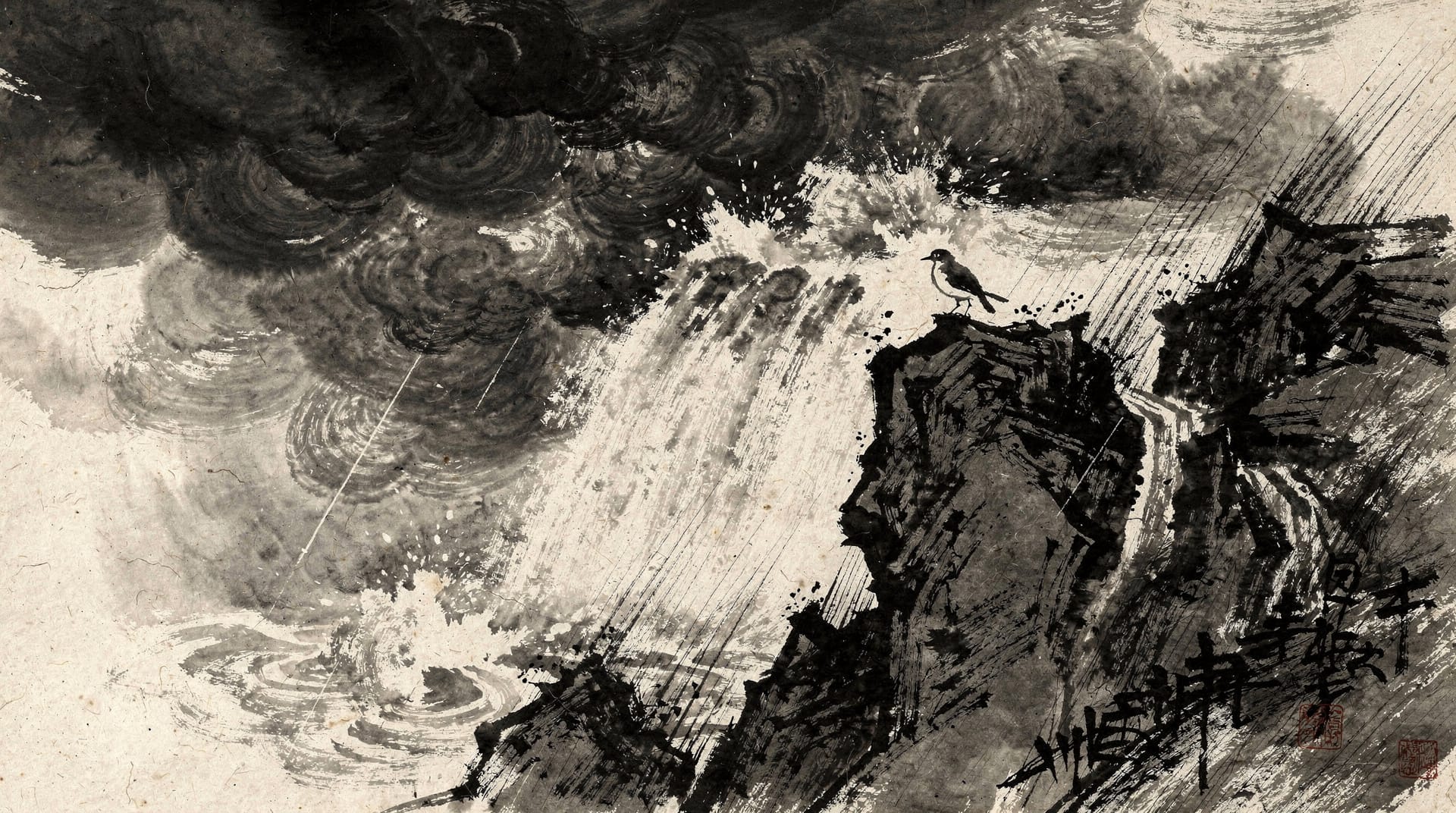
There’s a Daoist parable I think about often. A king holds a painting contest on the theme of peace. One entry shows a calm lake under a clear sky — still water, quiet mountains, not a ripple. Another shows a raging storm: dark skies, lightning, a river crashing through cliffs. The king chooses the stormy painting as the winner. Look closely and there’s a tiny bird sitting in a crack in the rock behind the waterfall. Completely at rest in the middle of chaos.
True peace is not the absence of a storm. It is rest within one.
That’s the posture. Not arrived. Still practicing. But no longer fighting the weather. The next time you’re flooded — angry, frustrated, overwhelmed — don’t try to make it stop. Pause. Notice what you’re feeling without acting on it. Then ask the question: what could I build with this energy if I didn’t waste it on the reaction?
This was written with the assistance of Claude (Anthropic). The ideas, experiences, and arguments are mine; the AI helped with structure, pacing, and iterative drafting.