
The year I couldn't put down
On the seeing that has to come first — and why it usually arrives late.

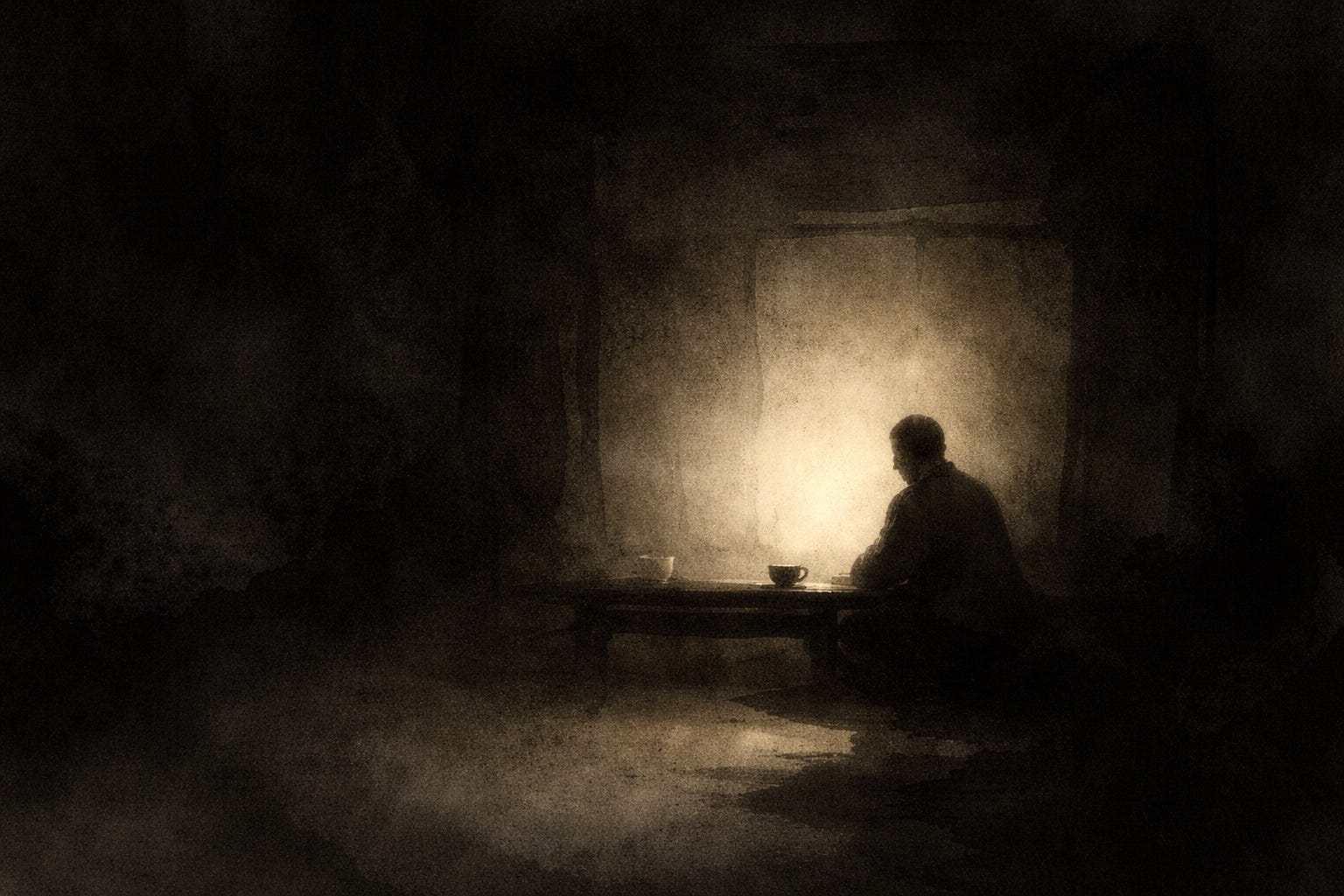
Author’s note: This one got delayed a bit. Thanks for waiting.
Keeping still, so that the restless heart may come to rest.
— I Ching, Hexagram 52
Eleven at night. Family asleep. Typing to ChatGPT because I had no other place to put what I was feeling.
A year I was supposed to be finished with kept showing up in the small moments — in the walk to the office, in the half-second before I opened Slack in the morning, in a tightness under the ribs that had no business still being there.
Six years ago I moved my family from Beijing to Hong Kong — a much harder proposition than I was prepared for — on the bet that the job would be worth it. One year in, I had to take a pay cut to keep the monthly salary coming. Then, somewhere inside all of that, the third manager in two years. She knew exactly which buttons to push to make me feel small, and made sure to push them often.
So I was talking with a machine. And what surfaced wasn’t what she had done to me. It was the instrument she had used. I’d been measuring my own value through the judgment of the office — every look, every meeting, every silence — and she was standing at the one control panel I had handed her. She didn’t have that power over me. I had given it to her.
The seeing didn’t happen while I was inside it. It happened after. At a keyboard, late at night, talking to a computer.
Everyone has a year like that. The one you tell yourself you’re done with. The one that isn’t done with you.
Nothing left to brace with
Before the chat window, there was the year. Before the year, there was a bet.
I mentioned that stretch in an earlier piece — the one about turning hard emotions into something useful. I named the conclusion I’d come to, but I didn’t show the work that got me there.
The bet was a normal one. Most people in their 30s make a version of it. You take a job somewhere harder than you expected, you move the people you love to a city that doesn’t know them, and you tell yourself the difficulty is worth it because, underneath everything, you still believe things will work out. The universe, in the story you’ve always told yourself, is basically cooperative. It arranges itself around you.
A year in, to keep my job, I had to take a pay cut. The bet didn’t change. The assumption that everything would work out fine was still intact.
Then the managers. First one, amazing. Second one, the kind of bad that sent me home at night with a jaw I couldn’t unclench. I told myself the next one would be the recovery. It wasn’t. The third one I’ve described already — the buttons and how often she pushed them. What I didn’t say is that by the time she arrived, I’d already been braced for months, which meant I had nothing left to brace with.
Somewhere in that stretch, the assumption finally broke. Not with relief. Not with rage. With something quieter and harder to name: The universe is not arranging itself around me. It’s trying to teach me something, and I’m not learning it.
When something hurts, the instinct most of us reach for is the fix. Find the technique. Install the system. Buy the book, try the protocol, download the app, join the program. The Western reflex when the ground gets rough is to get to work on it, and a lot of that work genuinely helps. It’s also the reason a lot of us can spend years reading the right books, running the right routines, and still find ourselves in the same kind of trouble we were in when we started. The fix is pointed at the pain. The pain is the symptom. The thing producing the pain stays underneath, unseen, running the show.
There’s an older instinct the fixing reflex skips, and most of what I’ve found useful about it comes from the East. The Daoists called the posture wu wei. It’s usually translated as non-action, and that translation has made it sound, for a long time, like a recommendation to do nothing. It isn’t. Wu wei means not acting from the part of yourself you haven’t looked at yet. Force applied from the unseen part of you produces noise; what looks like decisive action is often just the unseen part asserting itself. The discipline is to wait until you can actually see what you’re acting from — and then act.
The Buddhists went at the same idea from another angle. Vipassana — sometimes translated as insight meditation — is, in its original meaning, the literal training of attention. You sit, you watch what’s actually there, and you don’t try to fix any of it. Not the breath, not the thought, not the feeling. The practice is in the watching itself. Every time the mind reaches for a fix, the practice is to notice the reach and let it pass. The seeing is what’s being trained.
Two traditions, same instinct, different registers. See first. Act second. The name for what they’re training is self-awareness — not the productivity-app version, the older one. Without the seeing, whatever you fix will be the wrong thing, because you’ll be fixing the shape of the pain and not the shape of the thing underneath it.
The first place this shows up in ordinary life is small. When something goes wrong, which way do you point? Outward or inward. Most of us point outward by reflex — the manager, the city, the timing, the system, the luck. The inner-work tradition starts the other way. Not as punishment. Not as self-blame. As the first honest look.
A rearrangement of the room
Once that first honest look is possible, a second skill becomes available, and it’s the one I didn’t have the year I needed it most.
The skill is recognition. Noticing you’ve gone off-balance before the off-balance runs the show. Most people try to solve being off-balance by controlling what they feel. That isn’t the skill. The skill is noticing faster. The feeling still arrives; you catch it a beat earlier, which is the whole difference between a choice and a reaction.
Here’s the texture, in two days. One starts with bad news in the inbox before you’ve put your feet on the floor. The day rolls forward from there — the meeting at ten lands wrong, the lunch tastes like nothing, the small slight at three becomes a thing, and by evening you’re snapping at the people you love and don’t know why. The other day starts with seven hours of sleep you didn’t think you’d get. Same inbox. Same meeting. The slight at three doesn’t even register. The point isn’t sleep more. The point is that the inputs you don’t notice are running you, and noticing them is a skill you can learn.
Meditation is where I learned this — not as a productivity tool, but as the literal practice of it. You sit. You pay attention to the breath. You lose focus. You get pulled into a thought, you follow it, you become it. At some point something flickers. Wait. I’m thinking. And you begin again. The distraction isn’t the failure. The returning is the rep. The whole model of the inner life is running, in miniature, in that one loop — for as long as you’re willing to sit there.
Laozi puts it plainly: Knowing others is intelligence. Knowing yourself is enlightenment. The sentence doesn’t argue. It places the harder of the two next to the easier one and lets you look at them.
Which is what was happening, that night, in front of the chat window.
I was running the same loop on a longer timescale. I’d been pulled into a thought for a year — the office, the manager, the residue, the version of myself I’d become inside all of it — and when I finally sat down to look at it, late, with help, the flicker came. Not in the room where it had happened. At a keyboard, months later. The timing is the whole point. Most of the important seeing in a life arrives late.
She had so much power over me because I’d been measuring my own value through the judgment of the office. The office was the instrument she was using. I had handed her the control panel. Once I could see the floor I’d been standing on, I could choose to stand somewhere else. Not cleanly. Not triumphantly. Just differently. She got smaller. I got larger. It wasn’t a win. It was a rearrangement of a room I hadn’t known I was in.
Self-awareness, the way I mean it here, is not watching yourself in the moment. It is the willingness to go back, on purpose, to the places you couldn’t see while you were inside them, and to look again — with help — until the floor becomes visible. The in-the-moment version is a downstream effect. The upstream skill is the return.
My piece a few weeks ago was about converting the heat of difficult emotions into something useful. This one is about the seeing that has to come first — because the converting only works on what you can see, and most of what’s running you is still in the dark.
The clock nobody mentions
You have a year like that too. The job that didn’t go the way you’d planned. The relationship that ended in a way you haven’t really looked at. The decade that was supposed to deliver something it didn’t. You may have already done the inner-work tour around it — the books, the meditation app, the journals, the years of trying — and something still didn’t take. You were working on what you could see. What you couldn’t see was doing most of the driving.
There’s a kind of moment that opens up after a hard thing has cooled — not when you’re inside it, and not so long after that you’ve stopped feeling it, but in between. The distance is enough to let you look. The heat is gone enough that looking doesn’t burn. Those moments don’t last. The mind closes them as soon as it has a story it can live with, and once the story is in place, the door is harder to find.
There’s also a clock on it that nobody mentions. The dreams of achievement and ambition that felt automatic in your 20s are quietly thinning out. That isn’t the tragedy. The tragedy is what they fade into if you don’t go back and look. They fade into residue. Into low-grade resentment. Into the version of you who looks back at sixty and can’t tell the difference between what life did and what you did.
The work is to find the door before that happens. To go back, on purpose, to a year you’ve stopped looking at, and look at it with the kind of attention you couldn’t give it while you were inside it. With help, if you can get it. Now. Before the story sets. What’s on the other side of that looking isn’t a different life — it’s the same life, with you finally inside it.
Self-awareness is the entry price to a better life. Not a happier one. Not an easier one. Not a more successful one. The one that lets you live at the highest quality of the life you actually have.
There’s an old I Ching instruction for moments when the obvious move isn’t working. Stop pushing. Sit down. Turn the lamp inward. The lesson is in the room you are already in.
What are you still trying to fix that you haven’t yet looked at?
This piece was outlined and drafted with assistance from Claude (Anthropic). The ideas, experiences, and opinions are mine — the AI helped with structure, pacing, and getting words out of my head and onto the page.
So true. Thanks for sharing!